
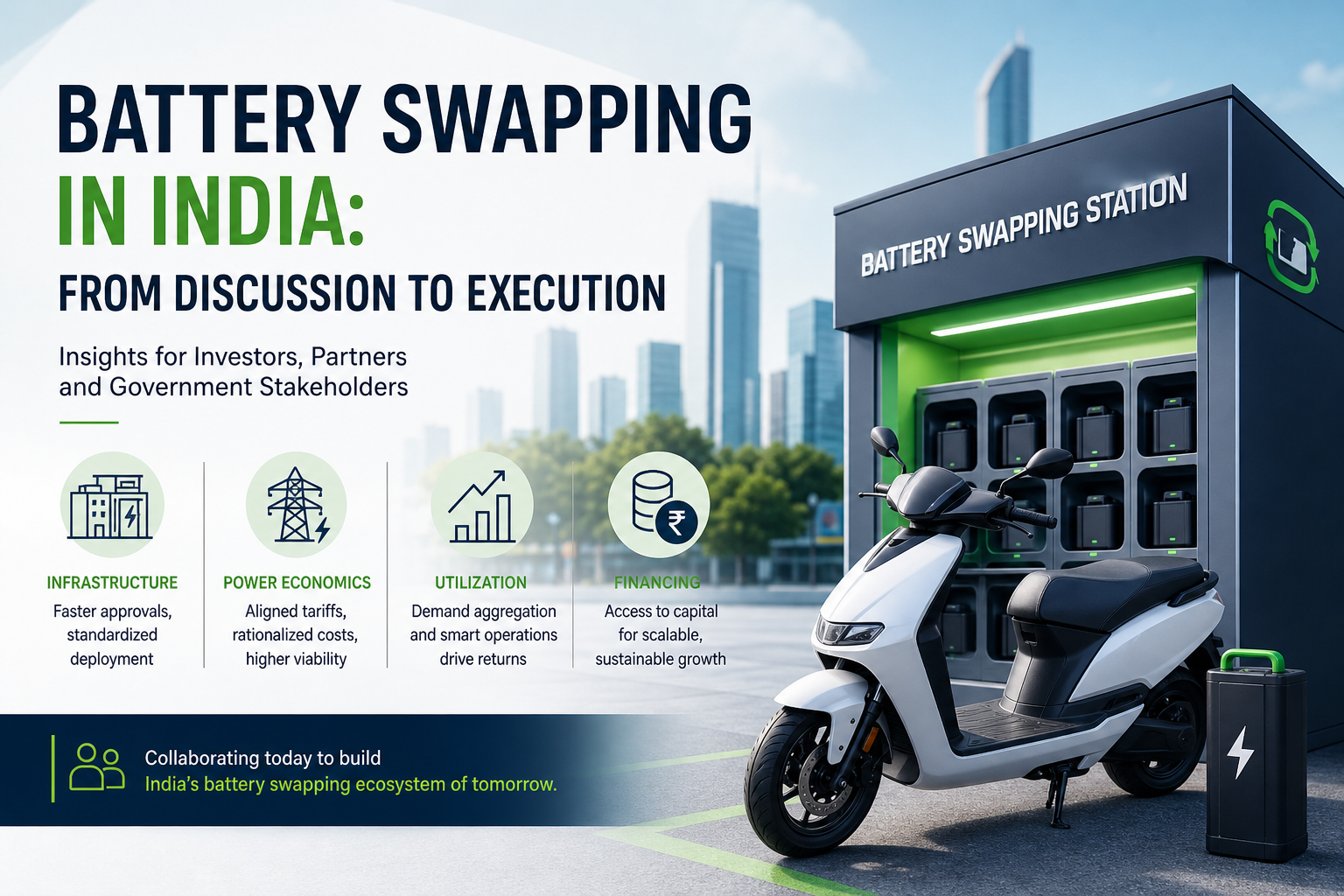
A perspective for investors, partners, and public sector stakeholders
India’s battery swapping ecosystem is at an inflection point. The question is no longer whether the model works—it is how to scale it sustainably across cities, use cases, and operators.
Recent multi-stakeholder discussions across industry and public-sector participants point to a clear shift: the ecosystem is moving from early experimentation to execution-focused scaling. For investors, partners, and government stakeholders, this is the moment to align on the structural levers that will determine success.
Where the ecosystem stands today
Battery swapping has demonstrated viability across segments such as last-mile delivery and commercial mobility. However, scaling remains constrained by a set of non-technological bottlenecks:
- Deployment friction across approvals and site access
- Misaligned power cost structures
- Low early-stage utilization
- Limited access to structured, affordable capital
These are not isolated challenges—they are system-level constraints that require coordinated action.
Four levers that will define scale
1) Infrastructure: speed and standardization
The ability to deploy stations quickly and consistently will determine how fast networks scale.
Current state
- Multi-agency approvals with timelines ranging from 30 to 90 days
- Lack of standardized station designs across cities
- Limited access to high-quality, pre-approved locations
What enables scale
- Streamlined approval processes and defined timelines
- Standardized station templates for faster replication
- Access to viable urban locations to achieve required density
Why it matters
Station density is directly linked to utilization. Without sufficient density, even well-capitalized networks struggle to deliver returns.
2) Power economics: the single biggest determinant
Energy cost is the largest component of cost per swap.
Current state
- Commercial tariffs in the range of ₹10–14/kWh
- Demand charges contributing 20–40% of electricity bills
What enables scale
- Tariff structures aligned to EV use cases (₹6–8/kWh range)
- Rationalization of demand charges
- Incentives for off-peak charging through time-of-day pricing
Why it matters
Even modest improvements in power cost can drive 20–30% improvement in unit economics, directly impacting viability.
3) Utilization: the core driver of returns
Utilization is the single most important operational metric.
Current state
- Early-stage networks operating at 20–30% utilization
- Viability typically requires 50–60%+ utilization
What enables scale
- Demand aggregation across fleets and retail users
- Coordinated rollout to ensure sufficient density
- Smart charging and operational optimization
Why it matters
Utilization determines whether assets generate returns or remain underutilized. It is the bridge between infrastructure and profitability.
4) Financing: unlocking capital efficiency
A significant portion of capital in battery swapping is tied up in batteries themselves.
Current state
- Financing costs in the range of 14–18%
- Limited availability of structured financing products
- Batteries often treated as inventory rather than assets
What enables scale
- Recognizing batteries as revenue-generating equipment assets
- Access to lower-cost financing (8–10% range)
- Standardized asset definitions and performance benchmarks
Why it matters
Improved access to capital can reduce payback periods from 4–5 years to 2–3 years, unlocking faster expansion and broader participation.
The role of data and phased standardization
There is broad consensus that interoperability and standardization are important—but timing is critical.
A phased approach is emerging as the most practical path:
- Start with safety and data standards
- Enable pilots across different models and use cases
- Use real-world performance data to guide future standardization
This ensures that decisions are driven by evidence rather than assumptions.
Moving from pilots to scalable programs
The next phase of the ecosystem will be defined by pilot-led, data-driven execution:
- Multi-city deployments across varied use cases
- Clear performance metrics (utilization, uptime, cost per swap)
- Structured data sharing to evaluate models
For government stakeholders, this enables policy grounded in real-world outcomes.
For investors, it provides visibility into risk and returns.
For partners, it creates clarity on where and how to engage.
What this means for stakeholders
For investors
- The opportunity is real, but returns are sensitive to infrastructure and power economics
- Focus on operators with strong execution capabilities and data visibility
- Capital efficiency and utilization will be key differentiators
For partners (OEMs, fleets, infra players)
- Collaboration will be critical to drive demand aggregation
- Integration across vehicles, batteries, and infrastructure will define success
- Early alignment on operating models can accelerate scale
For government stakeholders
- The ecosystem does not require heavy subsidies—but it does require structural alignment
- Policy clarity, streamlined approvals, and tariff alignment can unlock significant growth
- Pilot-led approaches can reduce risk and improve decision-making
The road ahead
Battery swapping in India has strong fundamentals. The next 12–18 months will determine how effectively the ecosystem can transition from fragmented deployments to scalable networks.
The path forward is clear:
- Reduce friction in infrastructure deployment
- Align power economics with operational realities
- Improve utilization through coordinated rollout
- Enable access to structured financing
With these levers in place, battery swapping can move from promising model to scalable infrastructure.
Final thought
Battery swapping is not constrained by technology—it is constrained by how effectively the ecosystem aligns around execution.
The opportunity now is to move decisively from discussion to deployment at scale.